|
Early Music Access Project is a rotating group of musicians bringing a wide range of early music to Charlottesville and surrounding communities.
|
|
CONNECTIONS
We embrace a broad definition of early music, to include medieval, Renaissance, baroque, new music composed for old instruments, Eastern traditions, and folk music. Exploring the connections between these various styles and traditions is at the heart of this project. |
COLLABORATION
We collaborate with non-classical musicians, visual artists, dancers, actors, poets, and a variety of other creative individuals and groups to create extraordinary experiences for our audiences. |
|
COMMUNITY
We are focused on presenting programs in the Charlottesville community and on partnering with other organizations that serve the community. Educational programming is an important part of every season. |
ACCESS
Every effort is made to keep programming accessible to a wide cross-section of our local community. We aim to reach diverse audiences through non-traditional venues, reasonable ticket prices, and engaging programming. |
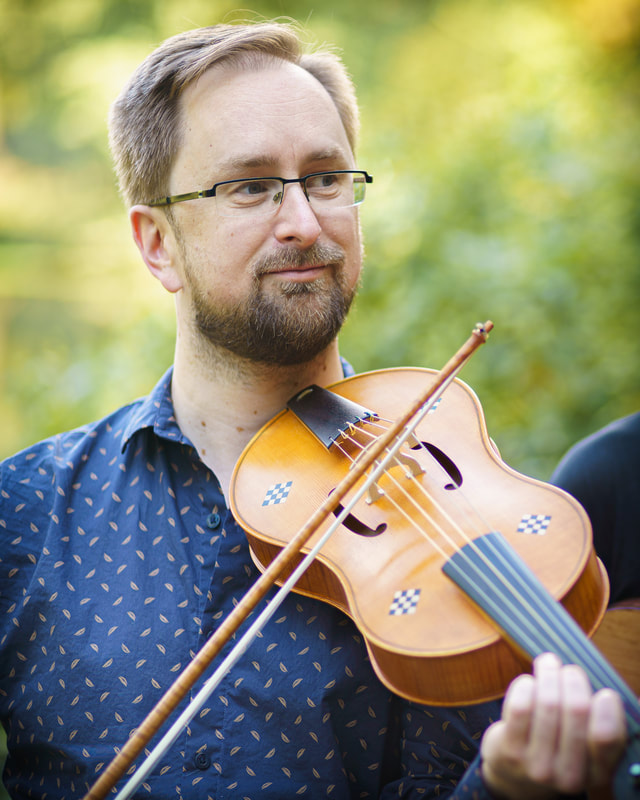
DAVID MCCORMICK, ARTISTIC DIRECTOR
|
Leading the charge for early music in the 21st century, David McCormick is a multi-instrumentalist, scholar, and educator recognized for curating imaginative performances, creating educational opportunities for students of all ages, and guiding prominent arts organizations through the challenges of our time.
In 2021, David took the helm of Early Music America as its sixth executive director, with the ambition of creating a more inclusive, equitable space for all who engage with historical performance. He was previously executive director of Shenandoah Valley Bach Festival and Charlottesville Chamber Music Festival, shepherding both organizations through pandemic-era challenges by creating dynamic virtual platforms. As artistic director of Early Music Access Project, David plays baroque violin and vielle (medieval fiddle) and transforms thoughtful research into dynamic programming. He has adapted his research on 17th-century composer Giovanni Antonio Pandolfi as a Case Western Reserve University graduate student into a one-act murder mystery play, slated for performance at the 2022 Indianapolis Early Music Festival. In 2020, David was awarded a fellowship with the Robert H. Smith International Center for Jefferson Studies to investigate the repertoire of free and enslaved Black musicians associated with Monticello, culminating in an ongoing series of live and virtual concerts, the “Expanding the Narrative” web series, and an executive producer credit for the feature film Black Fiddlers (in production). David is a founding member of Alkemie, a medieval ensemble based in New York City, with whom he has appeared at Indianapolis Early Music Festival, Music Before 1800, and Amherst Early Music Festival. He was also founding artistic director of Charlottesville-based baroque ensemble Three Notch’d Road, and has performed with Washington Bach Consort, Mountainside Baroque, North Carolina Baroque Orchestra, and as featured guest artist for the Bach-Handel Festival at his alma mater, Shenandoah University. He is a 2017 recipient of Shenandoah Conservatory’s Rising Stars Alumni Award. David’s two decades of experience as a public school and private lesson educator have led to a lifelong passion for outreach and audience engagement. David was president of the Charlottesville Music Teachers Association for two years and he has offered performance practice workshops for educators, students, and performers through Virginia Music Teachers Association, James Madison University, Fordham University, Fairmont State University, and others. His grant-winning educational outreach programs have reached thousands of young students throughout Virginia. David’s instruments include a vielle by Karl Dennis and violin by Jonathan Vacanti, with period bows by Louis Bégin, Michelle Speller, Ralph Ashmead, and H. F. Grabenstein. |
BOARD OF DIRECTORS
David McCormick (President) see bio above
Lisa E. Goehler (Treasurer) is treasurer of Early Music Access Project and the Crozet Community Orchestra. She is an amateur violinist and early music enthusiast.
Kristin Jensen (Secretary) is a project manager at the University of Virginia Library and serves on the Board of Directors for Victory Hall Opera.
Dana Patek
Lisa E. Goehler (Treasurer) is treasurer of Early Music Access Project and the Crozet Community Orchestra. She is an amateur violinist and early music enthusiast.
Kristin Jensen (Secretary) is a project manager at the University of Virginia Library and serves on the Board of Directors for Victory Hall Opera.
Dana Patek
ADVISORY BOARD
|
Blanton Alspaugh is a multiple-Grammy-winning producer with Soundmirror, Inc. of Boston.
Karin Brookes is Administrative Director of the Historical Performance program at the Juilliard School and former Executive Director of Early Music America. Ruth E. Chodrow is a pet house call veterinarian, adjunct biology professor at James Madison University, and an amateur recorder and bass viola da gamba player. Patrick Dailey (countertenor) is an active performer, advocate, and educator serving on the voice faculty of Tennessee State University. Sarah Darling is a baroque violinist and modern violist, playing with A Far Cry, Boston Baroque, co-directing the Harvard Baroque Orchestra, and serving on the faculty of the Longy School. David Deaton is an entrepreneur, nonprofit and business consultant who empowers organization during strategic change and success of operational excellence. Christina DeMarea is the General Director of Charlottesville Opera and serves on the board of the Front Porch. Jenn Dungan is an amateur cellist and a professional writer/editor/content strategist. Amanda Gookin (cello) is founder of Forward Music Project and Executive Director of the Shenandoah Valley Bach Festival |
Megan Gray is the Executive Director of the Youth Orchestras of Central Virginia, instructor at Woodberry Forest Private school, violist and educator.
Janet Kaltenbach is the Executive Director of the Charlottesville Symphony Society. Brian Kay is a specialist in ancient songs and historical plucked instruments and percussion. Miki Liszt is Artistic Director of Miki Liszt Dance Company based at McGuffey Art Center in Charlottesville. Loren Ludwig is a researcher and performer on historical stringed instruments. Fred Everett Maus is an Associate Professor of Music at the University of Virginia. Reginald L. Mobley is a professional countertenor and the Programming Consultant for the Handel and Haydn Society of Boston. David Perry is Executive Director of The Oratorio Society of Virginia, and is active as a professional clarinetist, educator, and photographer. Jonathan Woody is a bass-baritone and composer and active performer of early music. Among other groups, he performs regularly with the Choir of Trinity Wall Street in New York, NY. |